
Regulatory changes, compliance requirements and policy developments affecting soluble packaging and industrial film applications.
New EU Packaging Regulations and Their Impact on Soluble Packaging Solutions
Why Conventional Packaging Is Under Pressure?
 The European packaging industry is entering a major period of change with the introduction of the new Packaging and Packaging Waste Regulation (PPWR). As sustainability requirements become stricter across the European Union, manufacturers in the detergent, chemical, agrochemical, and construction sectors are being forced to rethink how products are packed, transported, and disposed of. Traditional polyethylene (PE) bags, liners, and sachets have long been the standard for industrial powders and chemical packaging because they are practical and cost-effective. However, they also generate large amounts of single-use plastic waste and often create disposal problems after use, especially when packaging becomes contaminated by hazardous materials. In many industrial applications, empty packaging cannot simply be treated as normal plastic waste, creating additional environmental and operational costs.
According to the European Commission, the new Packaging and Packaging Waste Regulation (PPWR) entered into force on 11 February 2025 and will generally apply from 12 August 2026. The regulation replaces the previous Packaging Waste Directive and introduces stricter requirements for packaging minimisation, recyclability, reuse, and waste prevention across all packaging placed on the EU market. From 2030, all packaging placed on the EU market must be recyclable, making packaging redesign a strategic priority for manufacturers. This means that for many industrial sectors, simply switching to recyclable plastic is no longer enough. Companies are now expected to redesign packaging systems with waste prevention and efficiency as core objectives.
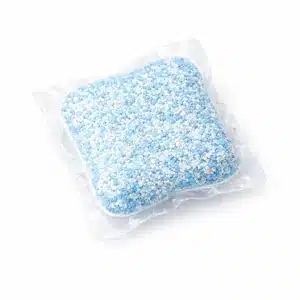
This is where water-soluble packaging offers a major advantage. Water-soluble film, especially Polyvinyl Alcohol (PVOH) film, allows the packaging to dissolve completely during use, becoming part of the application itself instead of generating empty plastic waste. In detergent pods, chemical dosing systems, textile chemicals, water treatment products, and construction additives, soluble packaging improves dosing precision, reduces operator exposure to hazardous substances, and eliminates the need to handle contaminated empty bags or sachets. This creates safer operations while helping manufacturers meet stricter environmental standards. Unit-dose packaging systems using PVOH film also support one of the main principles of the PPWR: packaging minimisation. By reducing unnecessary packaging layers and secondary waste, manufacturers improve both compliance and operational efficiency.
Although the regulation will apply broadly from 2026 onward, packaging decisions need to be made much earlier. Manufacturers that delay adaptation may face higher compliance costs, operational inefficiencies, and growing pressure from customers demanding more sustainable packaging solutions. Water-soluble packaging is no longer only an environmental choice—it is becoming a competitive advantage. Companies adopting soluble packaging systems today benefit from stronger sustainability positioning, reduced plastic waste, safer handling processes, and better alignment with future European regulations. The shift from traditional PE packaging to water-soluble film is not simply about replacing one material with another—it is about redesigning industrial packaging for a more efficient and sustainable future.
paco2026-06-04T15:28:33+00:00April 28th, 2026|Categories: Regulatory Updates|Tags: Chemical Packaging, EU Packaging Regulations, Polyvinyl Alcohol Film, Water Soluble Packaging|